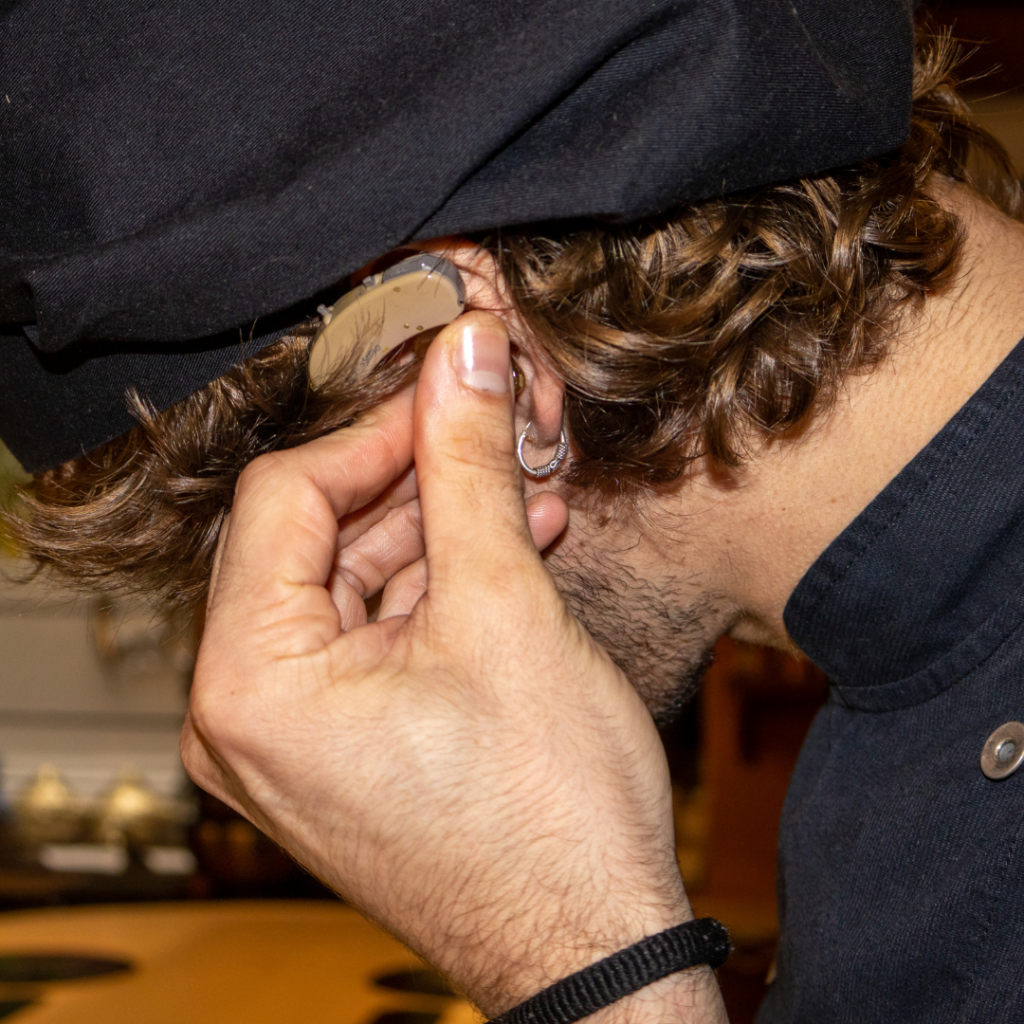
Maintaining dinner dialogue proves demanding when chaotic ambient noise strains your concentration and hearing. Our audiology clinic conducts specialized testing to evaluate hearing in both quiet sound booths and noisy simulations to isolate the underlying cause. Once we determine the cause of difficult hearing, we can help you find personalized solutions.
Why Everyday Hearing Fails in Busy, Noisy Restaurants
Quiet rooms provide a favorable signal-to-noise ratio, meaning a speaker’s voice is much clearer than the sounds around it. Dining venues establish an entirely contrary auditory challenge. Cross-talk, ambient music, dishware noise, and harsh acoustic reverberation interfere with speech clarity, forcing your brain to labor to extract the target voice.
Such difficulty frequently signals sensorineural high-frequency hearing loss, auditory processing dysfunction, or noise-induced cochlear damage. Visual limitations from low lighting, cognitive fatigue, and sitting farther away from conversational partners amplify speech degradation. Many individuals register normal audiometric thresholds on standard pure-tone screenings yet show profound deficits during speech-in-noise testing. Experiencing speech-recognition struggles in noisy dining venues warrants a formal audiological evaluation regardless of seemingly normal quiet hearing.
How Is High-Frequency Hearing Loss Diagnosed?
Our diagnostic process starts with a detailed case history reviewing problematic listening scenarios, occupational noise exposure, tinnitus, ototoxic medications, and familial genetics.
Clinical pure-tone audiometry identifies hearing threshold levels across various frequencies by delivering sounds through air and bone pathways. In high-frequency hearing loss, the audiogram reveals a sloping configuration where hearing acuity drops progressively as pitch frequencies increase. Further clinical diagnostics feature tympanometry to evaluate eardrum and middle-ear mechanics as well as word-recognition testing for speech comprehension.
Because testing in a silent booth does not mirror real-life restaurant environments, speech-in-noise testing supplies vital diagnostic clarity. It measures how well you recognize words or sentences as competing sounds become louder. Interpreted together, these clinical scores demonstrate whether listening struggles originate from loss of audibility, speech clarity deficits, auditory processing delays, or combined elements.
How Auditory Processing Difficulties Impact Adult Hearing
A diagnosed auditory processing disorder affects how the brain’s auditory cortex analyzes, organizes, and interprets sound. Even when the ears detect individual frequencies accurately, the central auditory system may falter at sorting overlapping voices, distinguishing close speech sounds, or processing fast-paced dialogue. Our protocol begins by thoroughly testing peripheral hearing before determining if a specialized central auditory-processing battery or interdisciplinary referral is warranted.
What Strategies Can Improve Hearing in Noisy Environments?
Targeted behavioral changes optimize the acoustic speech signal reaching your auditory system while providing clear visual context. Before dining out, choose a quieter restaurant or visit during an off-peak time. Restaurants featuring plush booths, wall acoustic panels, heavy drapery, carpeting, and sound-dampening materials provide superior listening compared to open rooms with reflective surfaces.
Upon entering the restaurant:
- Ask for seating positioned far away from open kitchens, noisy bar areas, ceiling speakers, and large parties.
- Sit with your back near a wall to reduce noise coming from behind you.
- Position yourself directly opposite your companions where direct lighting highlights their facial expressions.
- Minimize the physical gap separating you and the person speaking as much as reasonably possible.
- Angle your stronger-hearing ear toward the primary individual you wish to converse with.
- Ask the speaker to rephrase the missed portion instead of repeating everything.
- Actively confirm key information rather than smiling and guessing at ambiguous dialogue.
- Excuse yourself for a momentary quiet pause when listening exhaustion starts to mount.
- Request that friends speak with crisp clarity rather than speeding through dialogue.
- Raised or shouting voices warp acoustic phonetics and rarely improve speech intelligibility.
What Are the Best Tools for Hearing with Background Noise?
The best technology depends on the cause of the difficulty, the listening environment, and whether hearing loss is present. Customized hearing aids employ directional microphone beamforming, noise cancellation algorithms, and targeted dining programs to prioritize speakers in front while lowering ambient noise. Patients must uphold realistic expectations because modern amplification cannot strip out every ambient human voice completely.
Pairing your devices with a remote wireless microphone generates a substantial improvement in the direct signal-to-noise ratio. Positioned near or clipped to the speaker, the device transmits raw speech audio directly to paired hearing aids or external listening receivers. This reduces the effects of distance and surrounding noise.
Alternative assistive hearing tools include:
- Dedicated table microphones engineered to capture small-group dialogue
- Telecoils or hearing-loop systems in equipped venues
- Mobile speech-to-text applications delivering instant visual captions during dinner
- Advanced hearables incorporating assistive directional listening programs
- Sound-level meter applications and community-driven quiet dining guides
We can compare options, confirm compatibility, and teach you how to use the selected device.
How an Audiologist or Physician Can Improve Hearing in Noise
A professional clinical assessment moves beyond basic baseline statements like “I hear fine in quiet rooms.” We can review the places, speakers, and noise levels that cause problems and select tests that reflect those concerns. Your comprehensive workup may involve pure-tone hearing thresholds, middle-ear testing, recorded word recognition, and speech-in-noise measures. Dedicated central auditory-processing testing will be scheduled if your history and primary diagnostic testing indicate central pathway issues.
Abrupt auditory reductions, unilateral hearing shifts, or rapid functional deterioration require prompt assessment by an ear, nose, and throat physician. Personalized patient care establishes the true medical source of your listening problems instead of assuming ambient noise is solely responsible.
Contact Us for a Hearing Evaluation Today
If crowded restaurant settings cause you to feel disconnected, tired, or forced to guess at conversations, arrange a diagnostic hearing evaluation today. We will help you navigate hearing in noisy environments by implementing advanced hearing aid options, assistive accessories, or therapeutic auditory strategies tailored to your lifestyle.
Contact us to request an appointment and take the next step toward easier conversations.